The Nervous System and Digestion: Why Safety Is the Foundation of Healing
We live in a time where many people feel overwhelmed, rushed, or disconnected from their bodies. Stress, anxiety, and emotional pressure have quietly become part of everyday life, shaping how we think, feel, rest—and how we digest.
Digestive discomfort is often a signal rather than a problem to fix. It points to a state of disconnection from the body and an overactive mind, where the nervous system struggles to slow down and support digestion.
In this article, we will explore how the nervous system shapes digestion, why safety is essential for healing, and how gently reconnecting with the body can begin to restore balance.
Inherited Safety: Where Our Nervous System Begins
Our nervous system does not begin at birth—it begins in the womb.
During pregnancy, the developing fetus is exquisitely sensitive to the mother’s internal environment: her stress levels, emotional states, hormonal balance, sense of safety or threat.
Through hormones such as cortisol and through the autonomic nervous system, the mother’s body communicates continuously with the developing baby. In this way, we don’t inherit only genetics—we inherit a baseline nervous system tone.
• Was the environment calm or unpredictable?
• Was there safety, connection, or chronic stress?
• Was the mother relaxed, anxious, overwhelmed, or supported?
These early signals help shape how the child’s nervous system learns to interpret the world: Is life safe? Or do I need to stay alert? This early imprint does not determine our destiny—but it does set the starting point from which we experience life.
The Nervous System as the Architect of Experience
The state of our nervous system largely determines:
• how we perceive situations
• how we react to stress
• how well we digest food
• how we regulate emotions
• how deeply we can rest, connect, and heal.
In other words, we do not experience life as it is—we experience life as our nervous system interprets it.
From Brain to Gut: One Continuous Pathway
Anatomically, the nervous system is not limited to the brain. It begins in the most ancient part of the brain—the reptilian brain and brainstem, responsible for survival, reflexes, and basic bodily functions. From there, it travels down the spinal cord, branching into peripheral nerves that reach every organ, muscle, and tissue—including the digestive tract. One of the most important highways of this communication is the vagus nerve, which connects the brainstem directly to the heart, lungs, and gut. This is why digestion is never just about food.
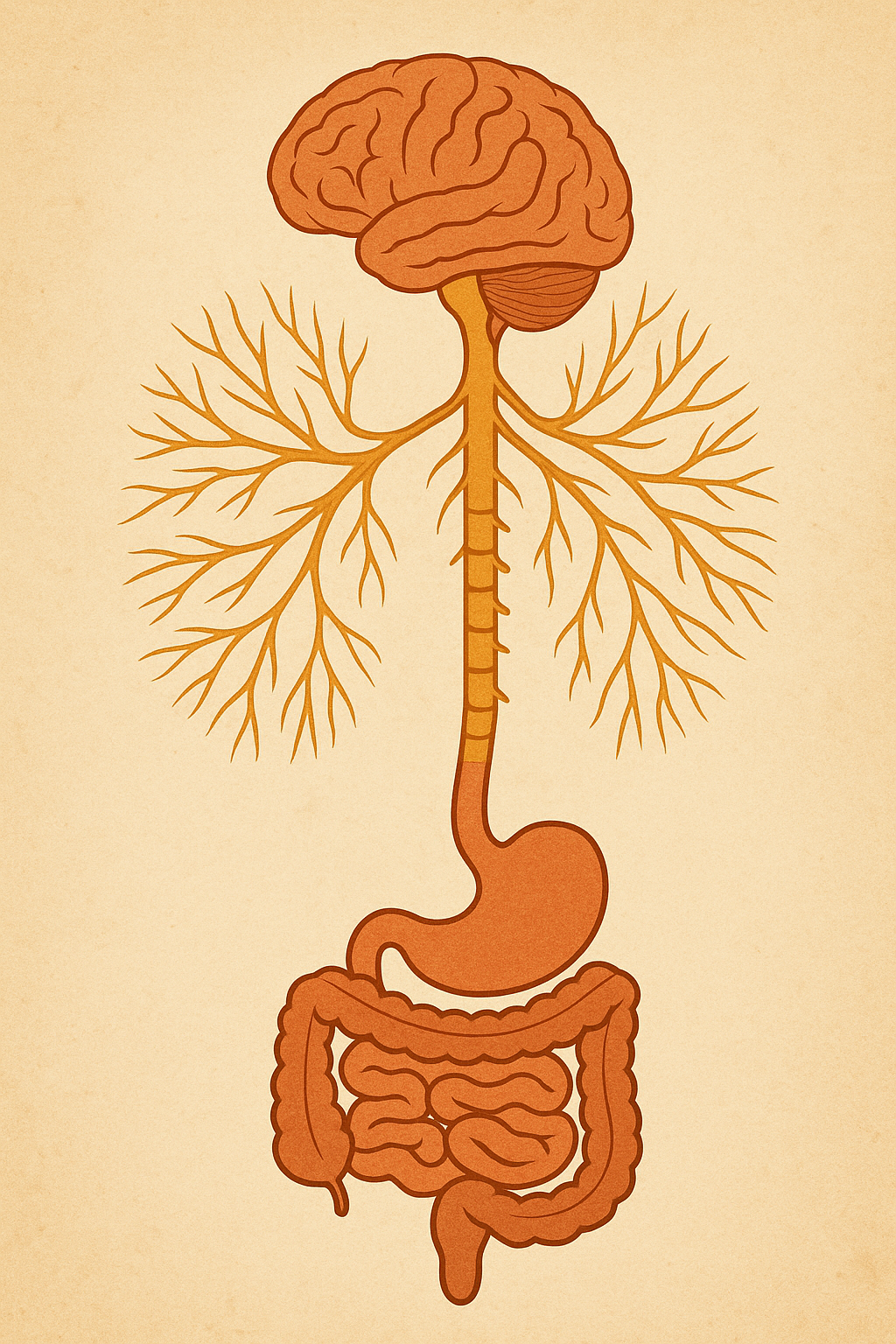
The Gut–Brain Axis: A Two-Way Conversation
The gut and the brain are in constant dialogue, a relationship known as the gut-brain axis.
• The brain influences digestion through stress, emotions, and nervous system activation.
• The gut influences the brain through the microbiome, immune signaling, and neurotransmitter production.
This communication is bidirectional and continuous.
In fact, over 80–90% of serotonin, a key neurotransmitter involved in mood, emotional stability, and well-being, is produced in the gut, not the brain. Other important neurochemicals, such as dopamine and GABA, are also strongly influenced by gut health and microbial balance.
This means:
Mental state affects digestion
Digestion affects mental state.
They are inseparable.
Sympathetic vs. Parasympathetic: Why Digestion Depends on Safety
The autonomic nervous system has two primary branches:
Sympathetic Nervous System
– “Fight, flight, freeze”
– Activated during stress, danger, urgency
– Blood flow shifts away from digestion
– Digestive enzymes, motility, and absorption are reduced
Parasympathetic Nervous System
– “Rest, digest, repair”
– Activated during safety and relaxation
– Digestive processes turn on
– Nutrients are absorbed, tissues regenerate
If the body perceives threat—real or perceived—it prioritizes survival over digestion. From the body’s perspective, digesting food is unsafe if danger is present.
This explains why chronic stress, anxiety, or unresolved trauma often show up as:
• bloating
• constipation or diarrhea
• IBS
• food sensitivities
• inflammation
• poor nutrient absorption
The issue is not only what we eat—but the nervous system state in which we eat and live.
A Key Understanding
Digestion is not just a mechanical process. It is a state-dependent biological function.
Healing the gut, therefore, often requires: • nervous system regulation • restoration of safety • slowing down • embodiment • connection
Food is essential-but it works best when the body feels safe enough to receive it.
What Science Is Now Confirming
For a long time, digestive disorders—especially functional ones like IBS (Irritable Bowel Syndrome)—were approached as purely gut-based problems. The focus was placed on food elimination, medications, probiotics, fiber, or suppressing symptoms.
And yet, for many people, these approaches brought only partial or temporary relief.
Now, science is catching up with what the body has always known.
IBS and the Nervous System: A Proven Link
Current research clearly shows that IBS and many other gut-related disorders are strongly linked to the state of the nervous system, particularly the autonomic nervous system.
IBS is now widely understood as a disorder of gut–brain interaction, not simply a structural problem of the digestive tract.
In many people with IBS:
• There is no visible tissue damage
• Lab tests often come back “normal”
• And yet symptoms are very real and often debilitating
What researchers are finding is that the issue is not only in the gut itself—but in how the nervous system is regulating the gut.
Visceral Hypersensitivity and Chronic Stress
One key concept emerging from research is visceral hypersensitivity.
This means the nervous system becomes overly sensitive to normal sensations in the digestive tract. Signals that would normally be neutral are interpreted as painful, urgent, or threatening.
Chronic stress, early life stress, trauma, or prolonged nervous system activation can:
• increase gut sensitivity
• alter gut motility
• change microbiome composition
• disrupt communication between gut and brain
Over time, the gut becomes trapped in a loop of miscommunication and hypervigilance.
Why Treating the Gut Alone Was Often Not Enough
When the nervous system remains in a state of chronic activation:
• digestion is impaired • inflammation is more likely
• the microbiome becomes less diverse
• healing signals are suppressed In this context, even the “right” diet or supplements may not work—or may work only temporarily.
This is why many people with IBS have tried:
• multiple elimination diets
• probiotics
• medications
• supplements with limited success.
The body simply cannot fully heal while it is still receiving signals of danger.
A Shift Toward Root-Cause Healing
Because of these findings, the medical and scientific approach to gut health is gradually evolving.
More integrative models now include: • nervous system regulation • stress reduction • trauma-informed care • mind–body therapies • breathwork • vagus nerve stimulation • somatic practices
These approaches do not replace nutrition—but complete it.
They address the root of the imbalance, rather than endlessly managing symptoms.
A New Paradigm of Digestive Health
We are moving away from the idea that gut problems are "just about food" and toward a deeper understanding:
The gut listens to the nervous system before it listens to the plate.
Healing digestion often begins not with restrictions-but with safety.
When the nervous system learns that it is safe to rest, to feel, and to receive, digestion can finally do what it was designed to do.
Even when a person has a nervous system shaped by early stress or adaptation, it does not mean they are destined to live this way forever.
The nervous system is plastic. It can change. And while this change is not fast, it is real.
Nervous system regulation happens gradually, through consistency, patience, and gentleness—and there is nowhere to rush. This process affects not only digestion, but the way we experience stress, relationships, rest, emotions, and life itself.
Creating safety in the body is not a quick fix, but it is the only path that brings harmony and balance into your life, far beyond digestion alone.
Healing does not come from doing more.
The body heals when it feels safe.
And nervous system regulation is not a technique to master, but a relationship to build.
In this space, we are not turning breath practices, supplements, or diets into another performance. There is nothing to push, force, or perfect.
The goal here is simple and deeply human: to help the body feel safe again.
Safety is created through gentleness—by calming the system, listening to it, and responding with care. Much like a baby who cannot regulate on its own, the nervous system softens when it feels held, understood, and not rushed.
There is no pressure to feel a certain way. There is only an invitation to slow down, to notice, and to meet the body where it is.
Why Breath Comes First
First Among all supportive tools, the breath is the most immediate and foundational way to communicate safety to the nervous system. Breathing is always available, requires no equipment, and directly influences the nervous system through the vagus nerve, which connects the brain and the gut.
It is important to say that not all breathing practices are regulating. Some forms of breathwork can be activating or stimulating, especially for sensitive or already overwhelmed nervous systems.
Our intention here is not stimulation—but settling.
The breathing we will explore is gentle, simple, and natural. It does not take long to practice, it is not complicated, and it asks nothing from you except presence. And yet, it has the power to signal safety to the entire body and support the nervous system in choosing regulation.
A Gentle Breathing Practice to Support the Nervous System
The breath is one of the simplest and most powerful ways to communicate safety to the nervous system. Unlike many other practices, breathing does not require effort, force, or control. It meets the body exactly where it is.
For nervous system regulation, we are not trying to breathe “better” or “deeper.” We are simply allowing the body to soften.
This practice focuses on gently extending the exhale. A longer exhale sends a signal of safety to the nervous system and activates the parasympathetic response — the state in which digestion, repair, and restoration naturally occur.
How to Practice
Find a comfortable seated or lying position.
Let your shoulders soften.
If it feels right, place one hand on your belly.
Begin by breathing naturally through your nose.
Now, gently guide the breath:
`Inhale through the nose for four seconds
`Exhale slowly for six to eight seconds, through the nose or softly through the mouth
There is no holding of the breath.
If counting feels stressful, let go of numbers and simply allow the exhale to be longer than the inhale.
With each exhale, imagine the body receiving a message:
There is no emergency. You are safe right now.
Continue for one to three minutes. If thoughts arise, that is completely fine. Gently return your attention to the exhale.
You may notice warmth, softness, or a sense of settling — or you may notice very little. All responses are welcome.
The nervous system learns through repetition, not force.
This practice can be used anytime — before meals, after stressful moments, or whenever the body needs reassurance.
Healing does not require intensity or force. With the nervous system, consistency matters far more than doing more or trying harder.
This is not about fixing something that is broken, but about gently returning the body to its natural state of balance—what we call homeostasis, the body’s innate ability to regulate, restore, and heal when it feels safe.
If you would like guidance, you can listen to a short, gentle breathing practice designed to support nervous system regulation and create a sense of safety in the body.
To listen to the guided breathing practice ckick the link below:
https://soundcloud.com/kateryna-shulikahealing/nervous-system-regulation-a-guided-meditation
*This information is educational and not a substitute for medical care.”